
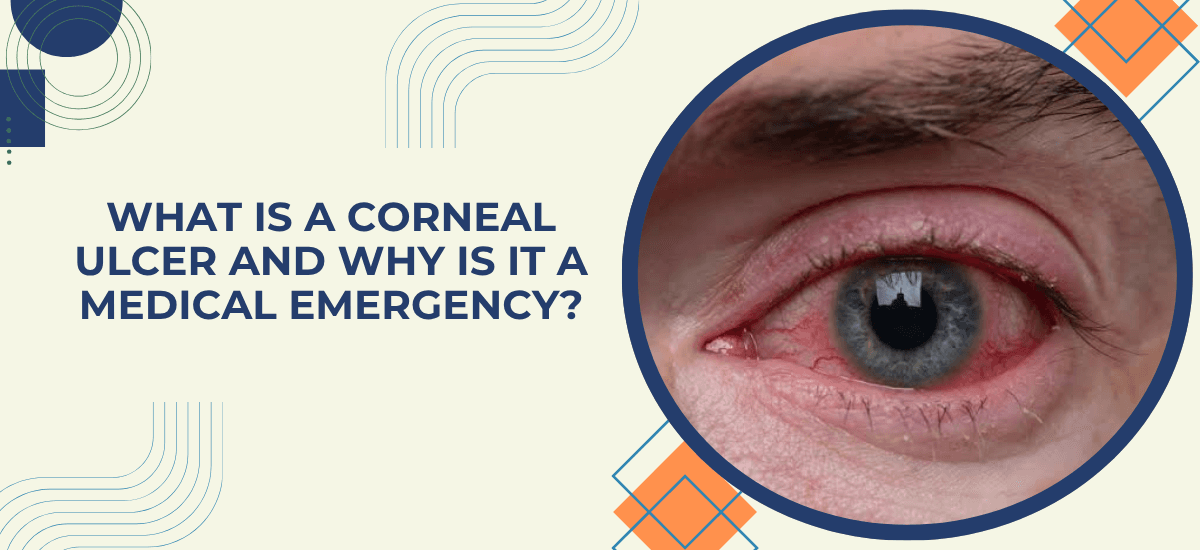
The cornea's basically the clear front window of your eye, the part light passes through before anything else happens. A corneal ulcer is an open sore right on that window, and it doesn't sit quietly and wait for you to get around to it. Left alone, it can chew through the tissue fast enough to cause permanent blindness in just a few days. Not weeks. Days. That's the part that catches people off guard, an eye that feels irritated on Monday can be in real trouble by Thursday if nobody looks at it.
Dr. Vaishal Kenia at Eye Hospital in Mumbai says: "This is genuinely one of the few things I tell people not to sleep on, literally. I've had contact lens wearers show up two or three days after their eye started hurting, thinking it was just irritation, and by then the ulcer's already deep. At that point we're not just treating an infection anymore, we're trying to save the cornea itself."
What Causes a Corneal Ulcer and What Does It Feel Like?
Infection is behind most cases: bacterial, fungal, sometimes viral, and contact lens misuse drives a lot of it. Sleeping in lenses, wearing them too long, skipping proper cleaning- all of it adds up. Our earlier post on wearing makeup with contact lenses actually covers a lot of the same hygiene habits that matter here too.
A scratch or injury to the eye can open the door for infection even if it seemed minor at the time. A fingernail, a stray branch, some grit that got in, any of it can turn into an ulcer if it's not cleaned up and watched properly.
Chronic dry eye wears down the cornea's natural defenses over time, which makes infection easier to take hold. Worth getting a ME-Check / SBM dry eye evaluation if dryness has been a recurring issue.
The symptoms come on fast and they're hard to miss. Sharp or gritty pain, redness, tearing that won't quit, sensitivity to light, blurry vision, sometimes an actual white or grey spot visible on the cornea. A lot of people also describe it as feeling like something's stuck in the eye that just won't go away.
Why Is It a Medical Emergency, and How Is It Treated?
Speed is really the whole story with this one. An ulcer can eat through tissue fast enough to perforate the eye, meaning the actual structure's at risk, not just the surface. Very few eye conditions move this quickly.
Diagnosis usually pairs a slit lamp exam with imaging. Tools like Pentacam HR and specular microscopy map the cornea's surface and show how deep things have actually gone.
Treatment usually means aggressive drops, antibiotics, antifungals, or antivirals depending on the cause, sometimes on an around-the-clock schedule for the first day or two. Severe cases sometimes need hospitalization just to keep that schedule tight. Our cornea treatment service covers this end-to-end.
Wait too long and scarring or permanent vision loss becomes a real possibility, and in the worst cases a corneal transplant ends up being the only path back to decent vision. That's exactly why doctors push people to come in immediately instead of waiting it out at home.
Why Choose Kenia Eye Hospital?
Kenia Eye Hospital runs 24x7 emergency eye care out of Santacruz (West), Mumbai, and a corneal ulcer is exactly the kind of thing that shouldn't wait for a next-day slot. The cornea team has Pentacam HR, specular microscopy, and Anterion right there on site, so imaging and treatment can start the same day instead of getting stuck in a referral chain.
NABH, QAI, and FEQH accredited. CGHS empanelled. Call +91 75064 99962 right away if there's eye pain, redness, or a visible spot on the cornea that isn't clearing up.
