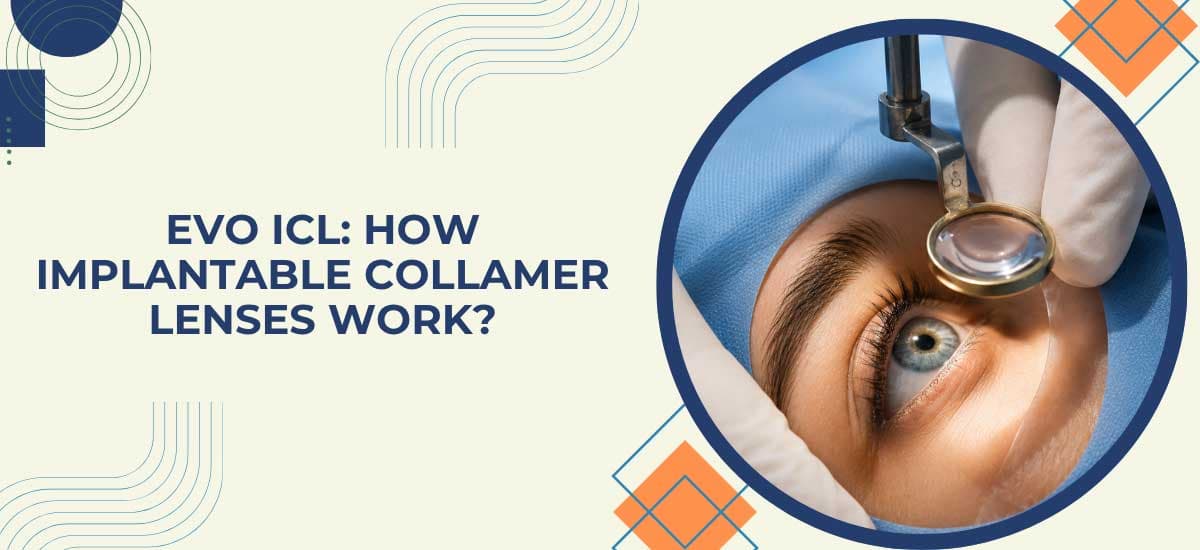
EVO ICL is a refractive procedure that corrects nearsightedness and astigmatism by placing a flexible, biocompatible collamer lens inside the eye. It works with the eye's natural optics to focus light onto the retina, offering a reversible, tissue-preserving alternative to LASIK. The cornea stays untouched.
According to Dr. Vaishal Kenia, a refractive and corneal surgeon at Eye Hospital in Mumbai, "EVO ICL is reversible, biocompatible, and a strong fit for patients whose corneas aren't suitable for laser procedures. At our centre, we use the FEMTO Z8 NEO, Pentacam HR, and Anterion to size every lens precisely before surgery."
How the EVO ICL Sits Inside the Eye?
Fifteen to twenty minutes per eye. Topical anaesthesia. No stitches, no bandages, no overnight stay. Most patients find the whole thing quieter than they expected.
- Tiny Incision: A 3 mm opening at the cornea's edge is all that's needed, small enough to self-seal completely on its own, with no sutures required and minimal disturbance to the surrounding tissue.
- Folded Entry: The lens is folded down to fit through that small opening, eased in carefully, then allowed to unfold naturally once it clears the entry point inside the eye.
- Final Position: It comes to rest in the posterior chamber, sitting behind the iris without touching your natural lens. Your eye's own focusing ability stays exactly as it was.
- Built-in Port: A tiny central hole in the EVO ICL keeps the eye's natural fluid flowing freely, which is why no separate laser step is needed after surgery the way older ICL designs sometimes required.
Before any of this happens, pre-surgery scans check anterior chamber depth and confirm the right lens dimensions. Both directly determine your candidacy for implantable contact lens (ICL) surgery.
Who Should Consider EVO ICL Over LASIK?
Not every eye tolerates laser correction. Some corneas are too thin, some prescriptions too strong, some patients too troubled by dryness. EVO ICL was built around exactly those situations.
- Thin Corneas: Laser correction works by removing corneal tissue, and there's a thickness floor below which that removal becomes unsafe. ICL simply bypasses this entirely since the cornea is never touched in the first place.
- High Prescriptions: The correction range covers -0.5 D to -18 D, which stretches well past what LASIK can reliably handle, making it the practical option for patients with strong minus power.
- Dry Eyes: Laser procedures reduce corneal nerve sensitivity temporarily and can make chronic dryness significantly worse for months post-op. ICL patients with pre-existing dryness tend to recover far more comfortably.
- Future-Proof: The lens is removable. For younger patients whose prescription hasn't fully settled, that's a real advantage. It's not a permanent decision locked in for life.
Still comparing laser options? Our breakdown of LASIK vs CLEAR vs PRK covers recovery time, candidacy, and long-term outcomes side by side.
Why Choose Kenia Eye Hospital for EVO ICL
Kenia Eye Hospital has been operating in Mumbai since 1998. Dr. Vaishal Kenia handles refractive and cataract surgeries with over two decades of hands-on experience. Dr. Pallavi Kenia runs clinical quality, patient care, and the hospital's paediatric and women's health programmes. Between the two of them, most situations that walk through the door aren't new territory.
The hospital carries NABH and ISO 9001:2015 accreditation, CGHS empanelment, and HOTA approval. For EVO ICL specifically, the Pentacam HR and Anterion handle pre-surgical lens sizing, and getting that sizing right is what actually determines whether the outcome is sharp or not. Call +91 75064 99962 to book a consultation.
