
Diplopia, commonly called double vision, is the perception of two images of a single object. It occurs when the eyes are misaligned, when the cornea or lens distorts incoming light, or when the nerves and brain that coordinate eye movement are disrupted. Treatment depends on the cause and ranges from updated glasses or cataract surgery to prism correction, eye muscle surgery, or management of an underlying condition such as diabetes or thyroid disease.
Brief double vision after a long day or when very tired is usually harmless. Double vision that appears suddenly, persists, or arrives with a headache, a drooping eyelid, or weakness is a different matter, and it needs prompt evaluation at an Eye Hospital in Mumbai.
“With double vision, the first question matters most: does it go away when you cover one eye? That answer tells me whether to look inside the eye or at the system that moves it. Sudden double vision, especially with other symptoms, is never something I would want a patient to wait on.” — Dr. Vaishal Kenia, Chairman and Medical Director, Kenia Eye Hospital
What Is Diplopia (Double Vision)?
Diplopia can appear as two images side by side, one above the other, or a faint ghost image overlapping the real one. It falls into two types, and telling them apart is the first step in finding the cause.
- Binocular diplopia appears only when both eyes are open and disappears when either eye is covered. It points to misalignment, or to a problem with the nerves, muscles, or brain that control eye movement.
- Monocular diplopia, or double vision in one eye, continues even with the other eye covered. It points to a problem within the eye itself, such as the cornea, lens, or retina.
Covering one eye briefly shows which pattern applies, and that answer helps the specialist narrow the cause quickly.
Seeing double and not sure why? A proper eye examination can identify the cause. Book an Appointment
What Causes Double Vision (Diplopia)?
The causes of double vision depend largely on whether one eye or both are involved.
Causes of Double Vision in Both Eyes (Binocular Diplopia)
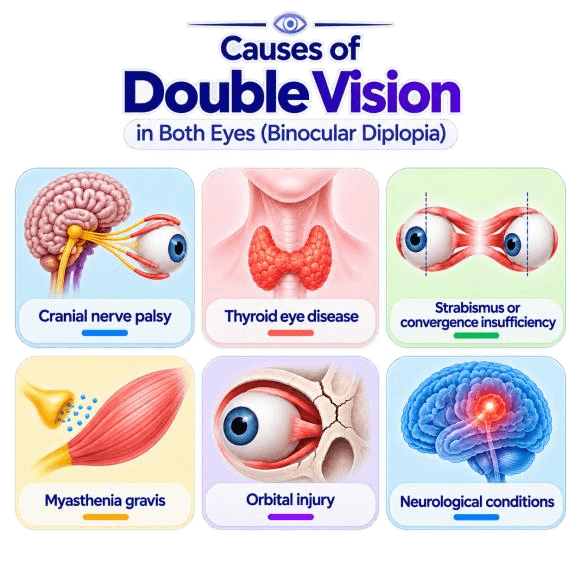
- Cranial nerve palsy. The third, fourth, or sixth cranial nerves control the eye muscles, and damage to any of them leaves the eyes unable to move together. Diabetes, high blood pressure, and head injury are common triggers.
- Thyroid eye disease swells the muscles around the eye and restricts their movement, often producing double vision when looking up or to the side.
- Strabismus or convergence insufficiency, where the eyes drift out of alignment or struggle to work together up close, sometimes appearing later in life.
- Myasthenia gravis, in which muscles tire easily, causing double vision that worsens through the day, often with a drooping eyelid.
- Orbital injury, where a fracture around the eye traps or weakens a muscle.
- Neurological conditions such as stroke, brain tumor, aneurysm, or multiple sclerosis, which make new double vision an urgent warning sign.
Causes of Double Vision in One Eye (Monocular Diplopia)
- Cataract, as clouding of the lens scatters light and creates a second, fainter image.
- Keratoconus or other corneal irregularity, where an uneven corneal surface splits incoming light. Our guide on early keratoconus signs covers what to watch for.
- Dry eye and uncorrected astigmatism, both of which distort the image reaching the retina.
- Retinal or macular disease, which warps the image at the back of the eye.
High blood sugar can affect both nerves and the retina, and our guide on diabetic retinopathy stages and treatment explains how regular screening protects vision.
What Are the Symptoms of Double Vision?
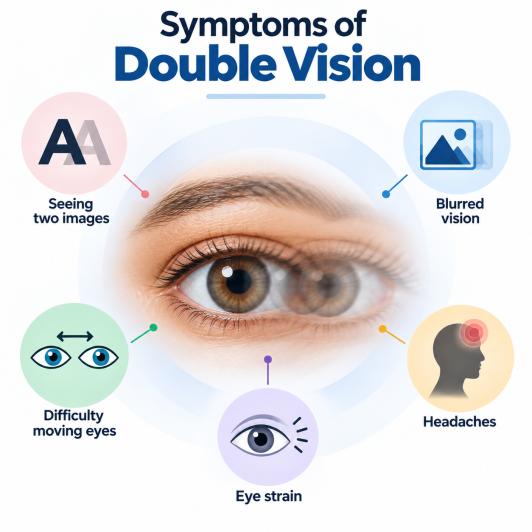
Double vision rarely occurs alone, and the accompanying symptoms often point toward the cause.
- Two images that sit apart or overlap, sometimes only when looking in one direction
- Eye strain, headache, or dizziness, particularly when moving the head
- A habit of tilting the head or closing one eye to get a single clear image
- Double vision that worsens late in the day, which raises suspicion of a muscle or nerve condition
Any new double vision, however mild, is worth reporting to a specialist.
Noticed new double vision along with headache or a drooping eyelid? Get it checked the same day. Book an Appointment or call +91 75064 99962
How Is Double Vision Diagnosed?
Diagnosis starts with a history of when the double vision began, whether it is constant or intermittent, and whether covering one eye stops it. The examination that follows usually includes:
- A cover test and eye movement assessment to detect misalignment or restricted motion
- Visual acuity and refraction, to rule out an uncorrected prescription
- A slit-lamp examination of the cornea and lens, along with a dilated look at the retina
- Prism measurements, which quantify how far the eyes are out of alignment
- Blood tests, and sometimes MRI or CT imaging, when a neurological or systemic cause is suspected
Double Vision Treatment: How Is Diplopia Treated?
Double vision treatment targets the underlying cause, and some forms resolve once that cause is addressed.
| Cause | Typical Treatment |
|---|---|
| Cataract or corneal irregularity | Cataract surgery, specialty lenses, or corneal treatment |
| Dry eye or uncorrected astigmatism | Lubricating drops, updated glasses or contact lenses |
| Cranial nerve palsy | Treating the cause, such as controlling diabetes, with prism glasses or patching while recovery occurs |
| Thyroid eye disease | Thyroid management, prism correction, surgery if needed |
| Strabismus or convergence insufficiency | Vision therapy exercises, prism glasses, eye muscle surgery |
| Neurological cause | Urgent referral and treatment of the underlying condition |
An eye patch or prism lenses can relieve symptoms while the cause is treated. Eye muscle surgery or botulinum toxin injections are usually considered only after the misalignment has been stable for several months.
Sudden Double Vision: When Is It an Emergency?
Most double vision has a manageable cause, but a few features change the urgency.
- Sudden onset, particularly with a severe headache
- A drooping eyelid, or one pupil larger than the other
- Weakness, numbness, slurred speech, or facial drooping
- Double vision after a head injury or blow to the eye
- Double vision with eye pain or sudden vision loss
Any of these calls for emergency evaluation.
Why Choose Kenia Eye Hospital for Double Vision Evaluation?
Double vision is one of the symptoms where the answer is not always inside the eye. A cataract can explain it, so can a weak eye muscle, and now and then the cause turns out to be neurological. Evaluation at Kenia covers the cornea, lens and retina as well as eye alignment and movement through its squint and cataract clinics, with referral to a neurologist when the findings point beyond the eye, drawing on more than 26 years of experience.
Kenia Eye Hospital provides eye examinations to help identify the cause of double vision and determine the appropriate treatment. Depending on the findings, patients may need further testing or referral to another specialist. Learn more about the hospital and its eye care services on the Kenia Eye Hospital website.
Dealing with double vision that isn't going away? Get a clear diagnosis. Book an Appointment or call +91 75064 99962
